-
2016-TODAY
Quite a long time as a building project... -
15.000cbm
going deeper underground and up again... -
SUBCONSTRUCTION
Upside down going new ways...
This project concerns the so-called substructure of the existing building House 1.
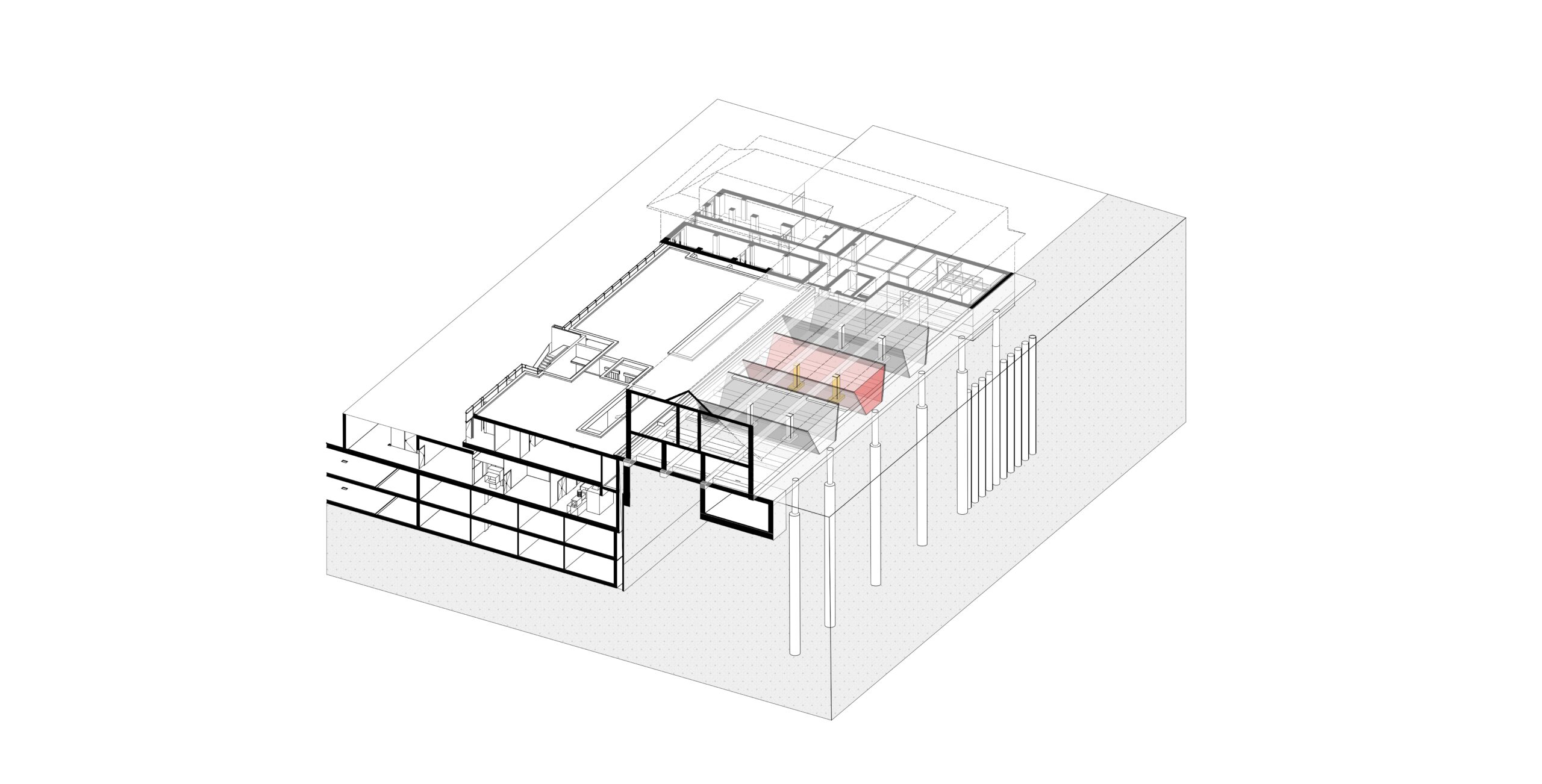
In connection with the planning for the new Building 5, we were tasked with designing a complete four-story substructure UNDER House 1. The geometric objective is to create a level connection between floors E0 to E-3 and the structure of Building 2 below House 1. This will further improve internal logistics and communication on campus. A key requirement is that Level+2 of House 1 remain operational. The closure of Level+1 should be kept to a minimum.
Conventional methods for supporting the building, using bored piles or micropiles, were rejected. The pile bundles created in Level E-3 would require very large diameters due to the high loads. The ceiling height in Level+1 is insufficient for these and similar machinery operations.
Therefore, we adopted an interdisciplinary approach. We completely disregarded the usual procedures and focused on the specifications and finding solutions. With this newfound freedom of thought, we arrived at the highly figurative concept of the existing building, House 1, as a bridge on piers; or, to put it even more simply: the multi-span girder and the necessary constructions, workflows, and processes. I presented my idea to the structural engineer, Mr. Paul Kaltenbach, during an evening brainstorming session. He immediately recognized and confirmed its feasibility from a structural engineering perspective.
The core elements of our approach are a reverse construction method employing methods outside the realm of civil engineering: The usual sequence of construction processes was "liberated" and conceptually enabled through the application of mining technology.
The solution concept, in the form of the original idea, can be summarized as follows:
The building, House 1, is considered a bridge and, if necessary, reinforced accordingly; beneath this "bridge," trenches are quickly and economically created down to the foundation at level 3 using mining milling machines; the "bridge" then rests on the remaining, secured rock piers during construction. The final supporting structure, in the form of three-story columns, will be erected between the rock pillars; the rock pillars will then be removed and the floor slabs constructed. Sufficient space for the necessary excavations is available parallel to the existing Building 1.” Patrick van Aaken